
Storybook Volume 2 - Part 2: Why So Few Songs Like These?
Previously in Part 1, we followed two songs across borders: one written for a school choir in Johannesburg, the other written for a workers’ choir in Lille. Both outlived the moments that made them. That raises the question behind Storybook, Vol 2, released last Friday: what carries a movement’s story forward, and why do so few people write the songs that could?
Justice movements are often built on the urgency of the hour. But urgency leaks. The meeting ends, the rally disperses, and the press release is drowned out by the next emergency. Urgency gets people into the street. Memory gets them back out the next morning.
Ann Rigney, a memory scholar from Utrecht University in the Netherlands, spent years studying how activism and protest are remembered once they stop making headlines. In her 2025 book, Remembering Hope: The Cultural Afterlife of Protest, she follows the trail from the Paris Commune to climate activism today. She finds that protest can live on long after the streets have emptied, if it is kept alive by the stories people tell, from one generation of activists to the next. She observes that as a matter of course, 19th century socialist meetings ended in singing together. Songs bonded a crowd to everyone who had sung them before, so the past was relived in the body and not only recalled in the mind. James Baldwin called the artist “a sort of emotional or spiritual historian.” A song is how a people remembers not only what happened, but what it felt like.
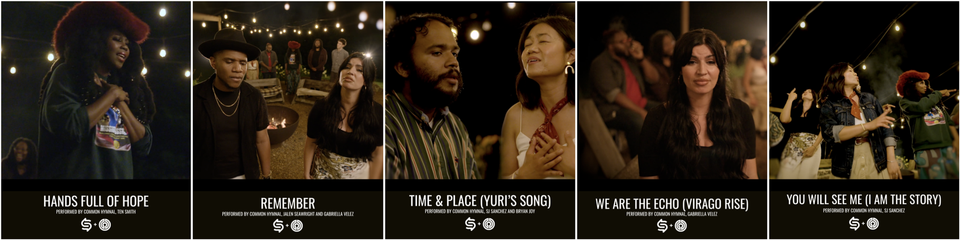
Two songs on the new record are about exactly this. “We Are the Echo (Virago Rise)” is sung by women “echoing foremother’s dreams, stewarding their wisdom.” The bridge of “Remember” says it about the land itself: “Every road remembers. Every tree recalls.”
Walter Brueggemann, the Old Testament scholar, saw something similar in the Hebrew prophets. Their deepest work, he argued, was to nurture an alternative consciousness, another way of imagining the world, in the face of an empire that insisted it had everything locked up and nothing could ever change. The prophets defied that claim, insisting that things could be different and giving people language to imagine it. When a culture stops carrying the memory of its own struggles and hard-won victories, movements are condemned to start over, and over, and over again. We’ve written more about this here.
Malcolm du Plessis, who instigated Common Hymnal, saw up close what songs can do. As an activist in the South African struggle, he pioneered a multi-ethnic, multi-lingual band at the intersection of worship and the justice movement. There, music, theater, art, and dance were never a sideshow to the struggle for freedom. In September 1988, the apartheid government banned three songs from the band’s second record, but the songs got out anyway. Nelson Mandela knew the power: “Politics can be strengthened by music, but music has a potency that defies politics.” A state can block a broadcast. It can’t stop a melody from sticking in people’s heads, minds, and imaginations.
So why are songs like these so rare? Not everywhere, to be clear. Movement music has never left the wider world: it still lives in hip-hop, in the freedom songs of the Black struggle, in nueva canción, in the songs of Indigenous movements. Our concern is narrower, and it’s about a space we know from the inside: Christian music. Part of the answer is economic. Capitalism does what it was built to do: it pays for what sells, and in our experience, conscience doesn't sell. The industry is very good at feeding us what we already feel, and far less interested in helping us feel what we’ve been avoiding. Hands full of comfort have no room for anything else. Christina Edmondson and Ekemini Uwan of Truth’s Table say it plainly on “Hands Full Of Hope”, the focus track of this record: “We can’t hold hope if our hands stay full.”
The uncomfortable truth is that Christian music is predominantly market driven. The market’s favorite genre is worship, and worship’s favorite subject is wonder, and rightly so. Awe is where worship begins, and a song that lifts a room toward God is a gift. However, Scripture’s songs of praise were seldom vague. When the Israelites crossed the Red Sea, they sang of the horse and rider hurled into the waves, giving thanks for a rescue they lived through. Journey through the Psalms and everywhere you will encounter precise references to collective and personal experiences. Specificity is powerful. But once a genre becomes profitable, it bends toward whatever appeals to the most people, drifting quietly toward empty vagueness. Details become casualties: the name, the wound, the circumstances, the challenge ahead.
We tried to write against that drift. “Time & Place (Yuri’s Song)” tells the story of one woman, Yuri Kochiyama. “You Will See Me (I Am the Story)” opens on a woman patting powder on her face before she steps into a role she has been handed. Generality dulls the power of worship to comfort and inspire. Consider the most popular songs sung in churches today, and how many of them can be understood to be about anything to anyone. Chase the commerce of wonder long enough and even wonder loses its power to astonish.
The rest follows. When nobody is paid to write songs for movements, nobody practices the craft, and a craft nobody practices is soon lost. In the Christian world especially, writing songs with a movement, in the room, for the room, has sadly fallen out of style. We are doing our best to keep it going.
When we began this work, we refused to photocopy a genre built for the broadest possible acceptance. We went looking for the gaps instead, the unsung places where grief and hope, praise and protest, lament and celebration are allowed to share a table. A God whose paths are beyond tracing out, would surely not pioneer a cookie cutter business, when everything He has ever made is an original.
That’s why CSA matters to us. An organization that has spent more than fifty years changing the church’s conversation with declarations, books, and policy has chosen to invest in stories, and in songs. Declarations change what a church says. Songs change what it sings on the way home. This partnership takes us straight into those gaps, and every song we bring back is a small act of resistance: music that wakes the conscience rather than sedate it.
A statistic can inform you. A story can follow you home. A song moves in. Lyric and melody braid together and play on a loop you never asked for, until the truth is something written in your heart. It hums along with you in the shower and in traffic. It’s there when you’re tucking your children into bed, lying awake with the day’s grief, or walking into the next meeting and the next defeat. It finds you when you’re alone, with no one beating a drum and no one trying to sell you anything. It quietly reminds you what you are fighting for and who you are fighting alongside.
Storybook, Vol 2 is out now: “Hands Full of Hope” with Truth’s Table, “We Are the Echo (Virago Rise)” with Virago Strategies, “You Will See Me (I Am the Story)” with Liberated Together, “Remember” with The Center for Restorative Justice, and “Time & Place (Yuri’s Song)” written for Yuri Kochiyama. Five organizations. Five stories. Five songs that didn’t exist last year.
We don’t have time to keep starting over.
Listen to Storybook, Vol 2, wherever you stream music.
Member discussion