
Storybook Volume 2 - Part 1: The Songs Behind the Songs
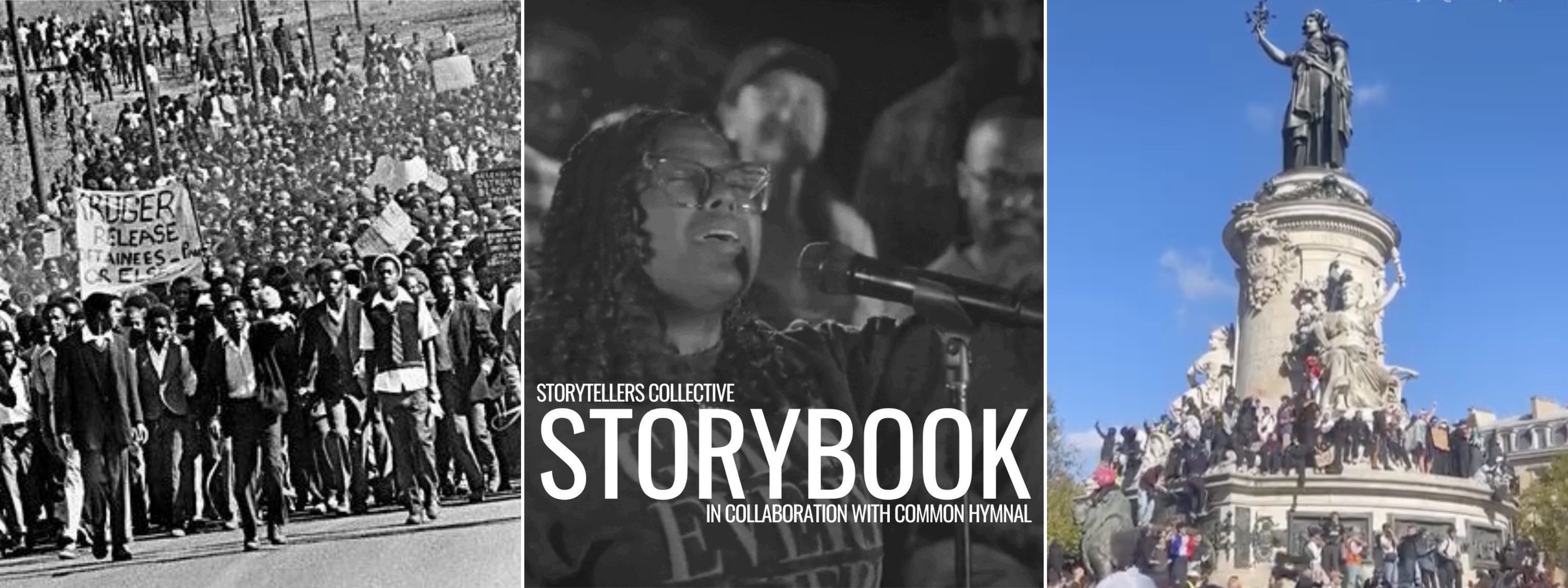
Ask a justice organization about its work and you’ll hear a story that could stop a room and break your heart in the same breath. Ask whether there’s a song that tells that story, and in the Christian world at least, the answer is almost always no.
This Friday October 23, we’re releasing Storybook, Vol 2, the second chapter of our multi-year partnership with Christians for Social Action, a relationship that has proved exceedingly enjoyable and fruitful. Each year, CSA gathers a cohort of justice organizations and helps them sharpen their stories, and each year we’re invited into the room with those leaders to set those stories to music, in all their particulars.
The record will speak for itself. This post takes the long view. Along the way you’ll meet a schoolteacher, a poet in hiding, a woodcarver, and a question that historians of protest keep circling: why does a movement reach for a song? Before there were manifestos, there were melodies. Next week, in Part 2, we follow the thread into the harder questions of writing songs for justice movements, and why so few people do it.
The record tells you what we made. These two posts tell you why.
I. Storybook
CSA is no newcomer to justice. It began in 1973, when about forty evangelical leaders — among them Ron Sider, John Perkins, and Jim Wallis — signed the Chicago Declaration of Evangelical Social Concern, a call to reject racism, economic inequality, militarism, and sexism. For more than fifty years CSA has changed the church’s conversation through declarations, books, scholarship, and organizing, and now it has made a bet on stories. As Executive Director Nikki Toyama-Szeto puts it, “Stories shape not only how we see the world, but how we live in it.” Some stories, we would add, need a melody.
In the first year of our partnership with CSA, the gathering of artists and leaders gave us seven songs, released this past March as the first Storybook.
- With Chasing Justice, we wrote “We Got Us,” a bilingual anthem of solidarity, and “Enduring God”
- With Leadership LINKS, we wrote “Get Up, Girl” and “Daughters of Vision,” both celebrating the leadership and courage of Black women shaped by faith and community.
- With A Rocha USA, a creation care organization, we wrote “Wildflower,” about a flower that waits in the dirt for wildfire to pass and then blooms.
- And with HopeWords, we wrote “Light of the World,” a benediction, and “You Don’t Know My Name,” which sings of a strip mined mountain where a grove of chestnuts now grows.
Common Hymnal has been developing this discipline over the years, as we’ve written songs with thought leaders such as Rev. Otis Moss III, Pastor Mike McBride, Lisa Sharon Harper, Jo Saxton, and Shane Claiborne, among others. Two prominent institutions have also asked us for songs of their own. For its Be Love Day in 2025, The King Center commissioned “Be Love”, a song that distills the core motivation behind Dr. King’s work. MLK knew what songs can do: he called freedom songs “the soul of the movement.” The Carter Center commissioned us to write and perform a song for the closing of its annual Human Rights Defenders Forum. A commission is an act of trust: someone hands you their testimony and asks you to give it back with a melody. Commissioned songs supporting the work of justice are an old practice and an almost lost art form, especially in the Christian world. We’re practicing it, so we thought you should know where it comes from.
II. Nkosi Sikelel’ iAfrika
A cornerstone of that history is South Africa — where the idea for Common Hymnal was born — and the story of “Nkosi Sikelel’ iAfrika.” In 1897, Enoch Sontonga, a teacher and choirmaster at a Methodist mission school near Johannesburg, wrote the hymn “God Bless Africa” for his students. Its words are plain and wide: God bless Africa. God bless all the people who live in Africa. Come, Holy Spirit, fall on all the people who live in Africa. By 1925 the ANC had adopted it as its anthem, and today it is part of South Africa’s national anthem. Nearly 130 years later, it is still sung across Africa. A hymn written for a school choir had become the song of a movement, and then of a continent. Nobody sets out to write an anthem. They write for the room in front of them, and sometimes the room gets bigger. Under apartheid, the song was banned. The irony and tragedy: the song they banned was a prayer. It was born in reverence, a plea for the Holy Spirit to fall on the nation. The state treated it as a threat.
The plan for the Soweto uprising was set. On June 16, 1976, Morris Isaacson High School morning assembly began the way it always did. It was 20 year old Thandekile Mkhize’s turn to start the hymns. She began with a favorite and then stopped. The Lord’s Prayer was supposed to come next. Instead, at the request of Tsietsi Mashinini, she sang “Nkosi Sikelel’ iAfrika,” a song that defied the law. By her own account, her stomach turned and her voice shook. She sang anyway. The students walked out. The song was the signal. Afterward, she was told, the police were looking for the young woman who started it, dead or alive. Her parents hid her school uniform and sent her away. Our founder’s band sang it too, and it got them into trouble more than once. They never recorded it. Singing it was enough. That is the tradition we come from: Common Hymnal takes its inspiration from the Praise and Protest of late-apartheid South Africa, where worship and the freedom struggle were inextricably intertwined.
III. L'Internationale
The practice goes back further still, and some of its songs have never left the street. In recent weeks, student protesters in Paris have been playing and singing The Internationale, a song written in that same city more than 150 years ago. Like Sontonga’s hymn, it is still fueling the movement. The story begins in 1871, in the wake of France’s defeat in the Franco-Prussian War, when the people of Paris formed a radical, largely working-class government of their own, known as the Paris Commune. In its ten weeks of existence it forgave unpaid rent, banned night work in the city’s bakeries, and decreed free schooling — until it was crushed by the national army. One of its elected council members, the poet Eugène Pottier, went into hiding and wrote a poem that looked past the defeat to what may come. It opens with an instruction: Stand up, you condemned of the earth. Its refrain dreams of a day when the Internationale, the worldwide solidarity of working people, will embrace all of humanity. Pottier set his words to a tune everyone already knew, the Marseillaise, because in a century when many working people could barely read, a borrowed melody could carry a poem farther than print. It was, in the truest sense, an underground song, and it has been coming back above ground ever since.
Then in 1888, a socialist leader in Lille named Gustave Delory, who had founded a workers’ choir, commissioned a woodcarver named Pierre De Geyter to set the movement’s songs to music, Pottier’s poem among them. So the tune that would travel the world was commissioned work: written by a worker, for workers, at the request of a labor organizer.
As long as the song borrowed France’s anthem, it belonged to France. With a tune of its own, it belonged to no nation, which was the whole point of its name. It was translated into many languages, and after the Russian Revolution it became the anthem of the Soviet state until 1944. A melody commissioned for a choir in one French town ended up sung around the world, to this day. Movements rarely remember their speeches. They remember what they sang.
The pattern repeats across the globe, from a women's suffrage march in Britain to a campaign anthem in Chile:
The movement finds a song, and the song carries the movement.
Storybook, Vol 2 is on every streaming platform this Friday, October 23.
The videos go public on YouTube Monday, October 26.
This is Part 1 of 2. Next week, in Part 2, we ask why movements forget, and why Christian music so rarely writes the songs that could help them remember.
Member discussion